Introduction
There’s a common belief that solar panels don’t work in winter. Is this true? Let’s clarify this misconception and explore what you need to know about solar power generation during the colder months.
Understanding Solar Generation in Winter
1. Winter for Solar Panels Isn’t What We Imagine
For many of us, November signifies autumn, but for solar panels, it’s the deep winter. Similarly, while February feels like the heart of winter, solar power generation sees it as early spring. This discrepancy is due to the way solar panels respond to sunlight, not the temperature.
2. Shorter Days Impact Solar Generation
In autumn and winter, daylight hours are shorter. By late December, the dark hours can last over 16 hours a day, significantly reducing the time available for solar generation. This shorter solar day results in proportionally lower energy production.
3. The Sun’s Low Angle
During winter, the sun travels lower on the horizon. This means the angle of sunlight hitting the panels, especially those set at summer or average angles, is less than ideal. However, vertically mounted panels, such as those on facades, can perform better due to their orientation, although they are not very common.
4. Frequent Fog and Overcast Days
November, December, and early January are often characterized by fog and overcast skies, which further diminish solar generation. The silver lining here is that under such conditions, panels generate almost uniformly low amounts of energy regardless of their orientation and angle.
5. The Effect of Snow
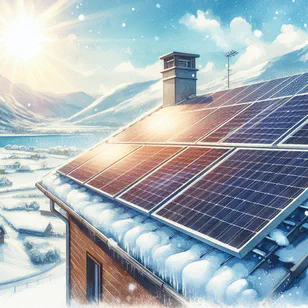
Snow can cover solar panels, blocking sunlight. Although panels can generate a minimal amount of power under a thin layer of snow, it’s not significant. The good news is that clearing the panels of snow can enhance their performance, as the reflected light from the surrounding snow can increase generation slightly.
6. Cold Weather Advantages
In cold, sunny weather, the voltage on solar panels can increase due to their physical properties, sometimes resulting in power output exceeding the panel’s nominal capacity by up to 15%. However, this boost typically lasts only a few hours a day.
Practical Tips for Improving Winter Solar Generation
1. Adjust the Angle of Your Panels
To prevent snow accumulation, set your panels at a steeper angle during winter. This helps the snow slide off more easily. Alternatively, you can use special brushes to clear the snow manually.
2. Increase the Number of Panels
If space and budget allow, consider installing more panels to compensate for the reduced generation during the winter months. More panels mean more potential energy capture, even when individual panel efficiency is lower.
3. Regular Maintenance
Ensure your panels are kept clean and free of debris. This includes not only snow but also any dirt or grime that can accumulate and block sunlight.
Conclusion
While it’s true that solar power generation is lower in winter, it’s far from non-existent. Winter isn’t just fog and darkness; it also brings clear, sunny days where solar generation can be surprisingly efficient. The most challenging period is from October 20 to January 20, but with the right strategies, you can still harness the power of the sun effectively.
Yes, your solar panels will generate power in winter, and this is much better than nothing. With proper planning and maintenance, you can optimize your solar power system to ensure it continues to provide valuable energy year-round.
This comprehensive guide aims to clarify the functioning of solar panels in winter and provide practical tips for homeowners. By understanding and adapting to the seasonal changes, you can make the most of your solar investment.