Introduction
Solar panels are systems of interconnected semiconductor converters that transform solar energy into DC electricity with standard voltages of 12, 24, 36, 48 V, and higher. Here’s an in-depth look at the different types of solar panels available and their unique characteristics.
Types of Solar Panels by Crystal Type
1. Polycrystalline Solar Panels

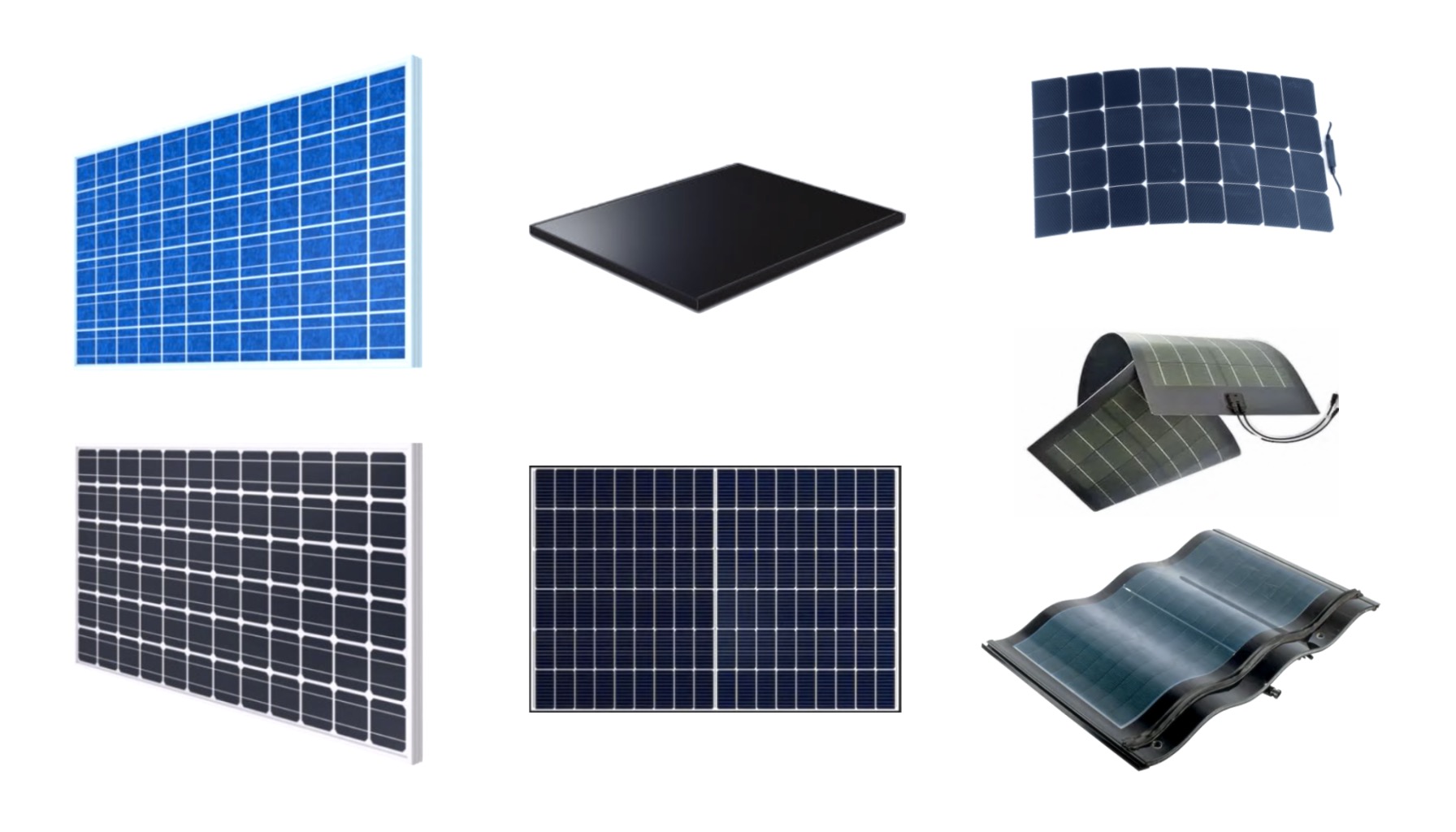
Polycrystalline solar panels, identifiable by their blue color, were the most common type of crystal used in solar panels until 2020. These panels typically achieved an efficiency of around 17%.
2. Monocrystalline Solar Panels

Monocrystalline solar panels, characterized by their black color, have become the most popular type since 2020. They are considered more durable than polycrystalline panels, with efficiency reaching up to 23.4% and continually improving each year.
3. Thin-Film Solar Panels

Thin-film solar panels come in various forms, including TF, CdTe, CIGS, and flexible a-Si, TF-Si. As of 2019, some models achieved efficiencies up to 22.9%. However, due to their cost and the requirement for transformer inverters and high panel voltages (around 100 V), they are less commonly used in home installations.
Which Type of Solar Panel is Best?
Monocrystalline panels are generally considered the best option. Although they were historically more expensive and thought to generate more power, by 2023, their cost has become comparable to polycrystalline panels. Continuous research and efficiency improvements make monocrystalline panels the superior choice. Although it was once believed that monocrystalline panels performed significantly better in indirect sunlight, the practical difference is less than 1%.
Types of Solar Panels by Mechanical Design
1. Traditional Solar Panels

Traditional solar panels, which can be made from any crystal type, consist of an aluminum frame, tempered glass, EVA encapsulant, solar cells, EVA encapsulant, a back sheet, and a junction box.

- Advantages: Best price per watt, mechanical durability.
- Disadvantages: High weight (starting from 17 kg for 280 W).
- Applications: Stationary, industrial, and home solar stations.
2. Semi-Flexible Solar Panels

Semi-flexible solar panels include a transparent PET or ETFE cover, EVA film, solar cells, EVA film, and a PET/TPT back sheet. These panels can bend up to 30 degrees and can be based on polycrystalline or monocrystalline cells.

- Advantages: Flexibility, lightweight, vibration resistance.
- Disadvantages: Shorter lifespan, higher cost per watt compared to traditional panels.
- Applications: Yachts, boats, RVs, portable stations.
3. Flexible (Amorphous) Solar Panels

Flexible solar panels, often made from thin-film materials, can bend up to 360 degrees.
- Advantages: High flexibility, better efficiency in cloudy weather.
- Disadvantages: High cost, high panel voltage, low efficiency, requires transformer inverters.
- Applications: RVs, rooftops, uneven surfaces.
4. Solar Shingles

Solar shingles, typically made from thin-film CIGS, serve as both roofing material and solar panels.
- Advantages: Replaces roofing material, durability, stylish appearance.
- Disadvantages: High cost.
- Applications: Rooftops of houses and buildings.
5. Bifacial Solar Panels

Bifacial solar panels, usually made from monocrystalline cells, capture solar energy from both the front and back, increasing energy output by up to 30%. For an in-depth look at how bifacial panels work, their benefits, and optimal use cases, refer to our detailed article on bifacial panels .

- Advantages: Up to 30% more power, durability due to dual-sided glass.
- Disadvantages: Weight, need for a good reflective surface.
- Applications: Ground installations, overhangs (e.g., canopies, bus stops).
Types of Solar Cells by Shape and Number of Busbars

Solar panels are composed of solar cells connected in series and parallel to achieve the desired voltage and current. Home solar systems often use traditional solar panels.

Solar cells can be full-sized (now rare) or half-sized (Half Cell), which generate more electricity when partially shaded.

The number of busbars (BB) in a cell varies, with multi-busbar (MBB) cells becoming common. More busbars reduce cell stress and increase longevity. Some cells have busbars only on the backside for higher efficiency but are more expensive.
For home use, traditional solar panels with half-cell technology and multi-busbar cells are recommended due to their efficiency and durability.