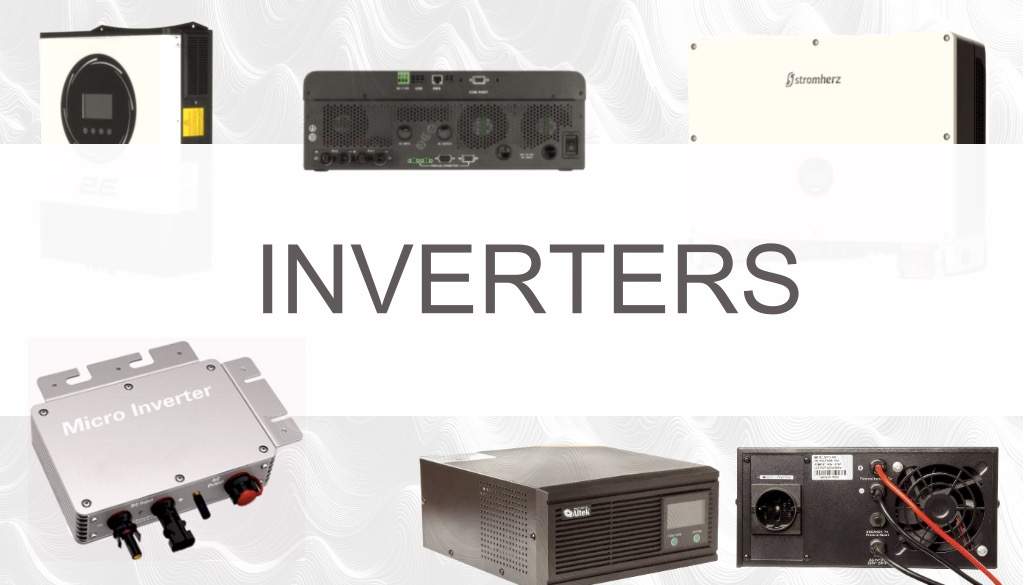
Inverter: Converting DC to AC Power
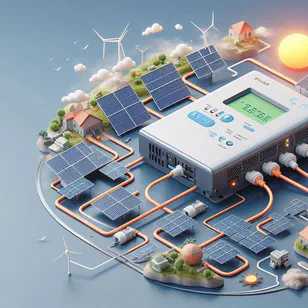
Inverters are essential components in solar energy systems, converting direct current (DC) from solar panels or batteries into alternating current (AC) compatible with household appliances and the electrical grid. This conversion is vital since most household devices and grids operate on AC power.
DC vs. AC: The Basics
Direct current (DC) is characterized by a constant voltage and current that flows in a single direction. DC power is commonly used in electronics like batteries, sensors, and motors, where a stable power supply is required.
Alternating current (AC), on the other hand, fluctuates over time, following a sinusoidal wave, represented by a green line on a graph. In most countries, AC power operates at a frequency of 50 or 60 Hz, which means it completes 50 or 60 cycles per second. AC power is the standard for household appliances and electrical grids because it can be easily transformed into different voltages and power levels using transformers and inverters.
Pure vs. Modified Sine Wave

When it comes to inverters, the output waveform is a critical factor to consider. Pure sine wave inverters produce a smooth, periodic wave that closely resembles the AC power supplied by the grid. This type of inverter is ideal for sensitive electronics and appliances, including refrigerators, air conditioners, and computers. These devices are designed to operate with a pure sine wave, ensuring optimal performance and longevity.
Graph c) shows a pure (clean, accurate) sine wave. A pure sine wave is a signal that is mathematically described by the sine function and has a smooth periodic shape. Its graph resembles a wave that continuously repeats with the same period, amplitude, and phase.
Modified sine wave inverters, however, generate a wave that is not as smooth and may cause issues with certain appliances. While they can be used with simpler devices like LED lights, phone chargers, and electric cooktops, they are not recommended for equipment with inductive loads or motors, as this can lead to improper operation, increased noise, and potential damage over time.
Graphs a) and b) show modified sine waves, which have different deviations compared to a pure sine wave. A modified sine wave is a type of current that resembles a sine wave but has less accuracy and uneven transitions between peaks and zeros. It can be produced using a set of rectangular signals composed of different frequencies and amplitudes.
What Are the Parameters of the Local Grid and Household Appliances?
Local grids and household appliances have been designed for decades to operate with pure sine waves, so it is essential to purchase an inverter that provides a pure sine wave.
What happens if a household appliance is connected to an inverter with a modified sine wave? Most appliances with inductive loads and motors (gas boilers, refrigerators, air conditioners, pumps, computers) will not function correctly and may produce unusual noise, eventually leading to failure.
Devices that can operate on a modified sine wave include LED lamps, phone chargers, and electric stoves, which may work fine with a modified sine wave.
Most household appliances are designed to work with a pure sine wave, which makes it crucial to select an inverter that matches the specifications of your home’s electrical grid.
Types of Inverters with Pure Sine Wave
Since household appliances typically require a pure sine wave, we will focus only on inverters that provide this.
Inverters are categorized into the following types:
Interactive OFF-line Uninterruptible Power Supply (UPS): This includes an inverter, sometimes a voltage stabilizer for the grid (AVR), an “input” cord from the grid (AC in), an “output” socket for the load (AC out), battery input cables for UPS with an external battery, and a charger from the grid.

- OFF-line vs. ON-line UPS: In addition to OFF-line UPS, there are ON-line UPS or double-conversion UPS. The difference is that OFF-line UPS switches to battery operation in 20 ms when the grid goes down, while ON-line UPS switches in 0 ms, which is crucial for some sensitive equipment.
- Small-Capacity UPS: These are often equipped with a built-in battery with enough capacity to power the load for 5-15 minutes, allowing enough time to properly shut down a computer, machine, or similar. Such UPS typically have a modified sine wave, so we won’t discuss them in detail.
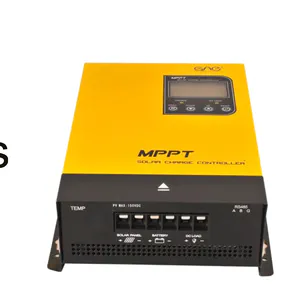
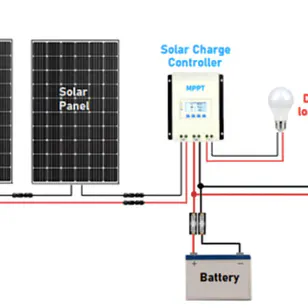
Autonomous OFF-line Solar Inverter (UPS for solar panels): This consists of an inverter, a charger from the grid, a PWM or MPPT solar charge controller (one or more inputs), battery input, grid input AC in (one or more), load output AC out (one or more), and various communication ports. There are also ON-line versions of such inverters, though the technology is often pseudo-online.

Grid-Tie Inverter (online): This includes an inverter, an MPPT solar controller (one or more), and a synchronization unit with the grid. A battery cannot be connected to this type of inverter.

Applications:
- Generation of energy for sale to the grid.
- When connected to a special generation limiter, most models can power home consumers when the grid is connected.
- For companies with high tariffs, it reduces electricity costs when connected to a generation limiter.
- Can increase power for self-consumption when grid power is limited (requires a generation limiter).
Drawbacks: The main drawback of this inverter is that it stops working when the grid goes down and does not allow for battery connection.
Microinverters: These are a subcategory of grid-tie inverters, but they connect to one or two solar panels instead of a large array.

Hybrid Inverter (grid tie + offline): This combines all other types of inverters with the ability to generate power for the grid. It includes an inverter, an MPPT solar controller (one or more), battery input, a synchronization unit with the grid, grid input AC in (one or more), load output AC out (one or more), and various communication ports.
- Important: Some sellers may incorrectly label any inverter with a solar input as a hybrid inverter, but this is not accurate.
- Applications:
- Generating energy for sale to the grid.
- Saving energy for households or companies by partially or fully consuming solar energy.
- Advantages: Combines all other types of inverters, works when the grid is available and when it is not, and some models can operate without a battery, using only solar panels.
- Drawbacks: The main drawback is that these inverters are more expensive than other types.
In conclusion, a specific type of inverter is suitable for each task, or a universal hybrid inverter can replace any type of inverter at a slightly higher price.
Conclusion
Selecting the right inverter for your home or business is crucial for ensuring the efficiency and longevity of your solar energy system. While modified sine wave inverters may be cheaper, they are not suitable for all applications. Pure sine wave inverters are the better choice for most household appliances, especially those with motors or sensitive electronics. For the best performance and reliability, consider your specific energy needs and the types of devices you intend to power when choosing an inverter.